

ESP32 Auracast: Does It Work? Best MCUs for LE Audio
Many teams searching for "ESP32 Auracast", "Auracast ESP32" or "ESP32 LE Audio" are not starting from a blank PCB. They already have a product: a PA system, museum player, conference DSP, set-top box, industrial HMI or an ESP32-based IoT device that plays or routes audio today.
The practical question is rarely "rebuild everything for LE Audio". It is:
How do we add Auracast to a legacy system without rewriting the main firmware stack?
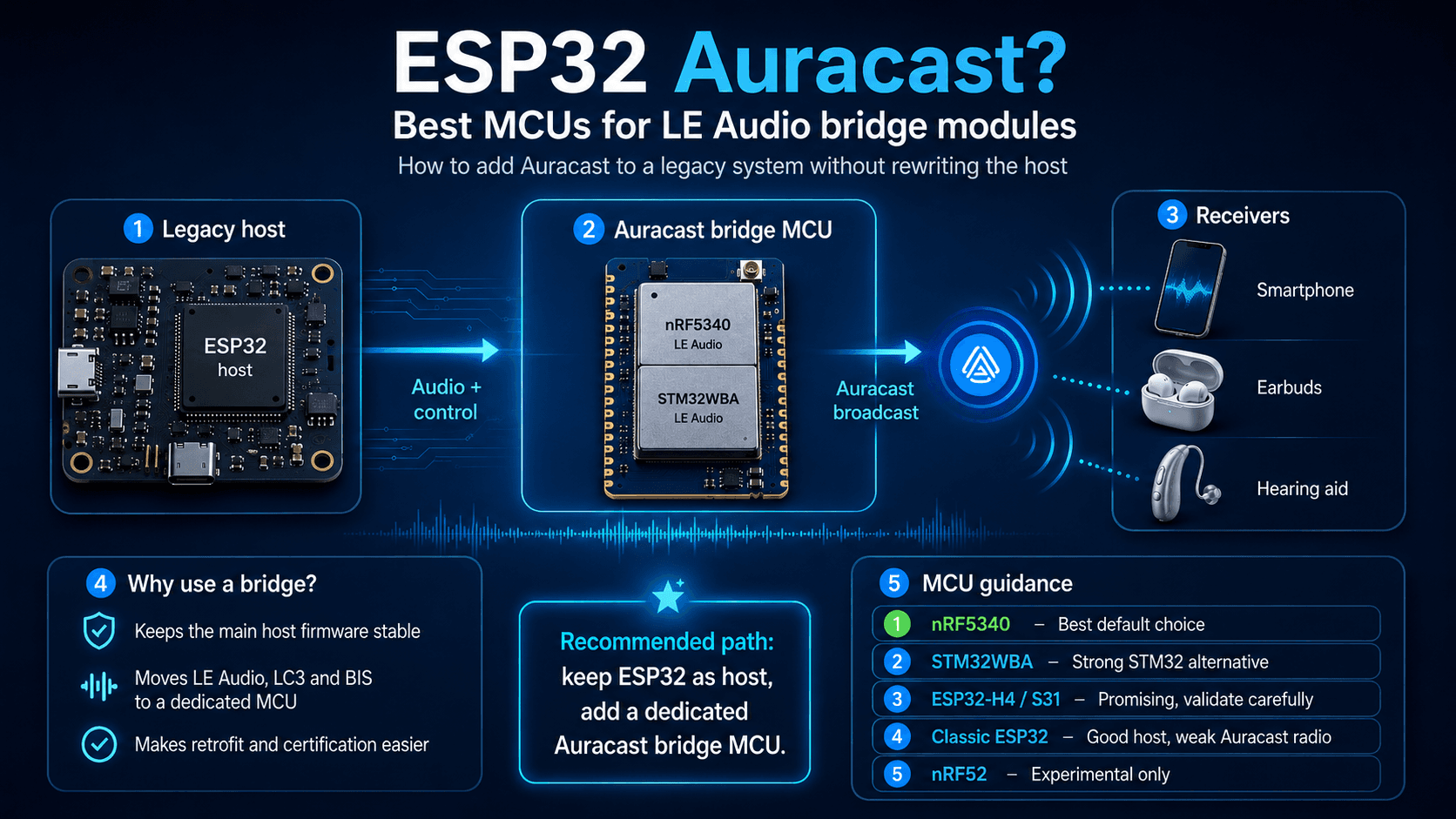
Our preferred answer is an Auracast bridge module: a secondary MCU that owns Bluetooth LE Audio, LC3 and Broadcast Isochronous Streams, while the existing host keeps doing what it already does well. The main system feeds audio and control over a simple interface. The Auracast MCU turns that into a standards-based broadcast for phones, earbuds and hearing aids.
That architecture also clarifies the ESP32 question. Classic ESP32 is often fine as the legacy host. It is usually a poor choice as the Auracast radio. For the bridge itself we start with Nordic nRF5340, treat STM32WBA as a strong alternative, and only evaluate newer ESP32 families when the exact chip and SDK clearly support LE Audio.
Drop-in Auracast for ESP32
Need Auracast on ESP32 without a full LE Audio stack rewrite? CastBridge is a companion module with a simple UART/I2S API and an open-source ESP32 library — broadcast audio without redesigning your firmware.
Get early access to CastBridgeWhy a secondary MCU beats forcing Auracast onto the host
Auracast is not another BLE GATT feature. It needs continuous audio, tight timing, LC3 encode or decode, Broadcast Isochronous Streams, periodic advertising, stream metadata and interoperability with consumer receivers.
Trying to bolt that onto an overloaded application MCU creates risk:
- The host firmware becomes much harder to maintain
- Real-time audio and product logic fight for CPU and memory
- Certification and radio bring-up get tangled with application releases
- Legacy products that already ship cannot be upgraded cleanly
A dedicated Auracast module isolates that complexity. The host stays stable. The bridge can be developed, certified and swapped as its own unit.
How an Auracast bridge module works
Typical split of responsibility:
Legacy host (primary MCU or SoC)
- Plays, mixes or receives the original audio
- Owns product UI, networking, storage and business logic
- Sends PCM/I2S audio, USB audio, or encoded frames to the bridge
- Controls stream name, language, start/stop and volume over UART, SPI, I2C or USB
Auracast MCU (secondary module)
- Runs the LE Audio / Public Broadcast Profile stack
- Handles LC3 and BIS timing
- Advertises the Auracast stream
- Keeps broadcast stable under real RF conditions
This is why the pattern fits legacy systems so well. An airport announcement box, museum player or ESP32 media node does not need a full Auracast rewrite. It needs a reliable audio-out path into a small LE Audio bridge.
Common integration patterns:
- I2S audio + UART control from an existing MCU
- USB audio gadget / host bridge for PC or DSP platforms
- Line-in or SPDIF into the Auracast module for analogue legacy gear
- Drop-in daughterboard next to an ESP32, STM32 or Linux SBC that already ships
ESP32 Auracast and LE Audio: does it work?
ESP32 is popular, cheap and easy to source, so "ESP32 Auracast" is a natural search. The important detail is that ESP32 is a family, not one chip — and the role matters.
As the legacy host: yes, often. Many products already use classic ESP32, ESP32-S3 or similar for Wi-Fi, UI or media. Keeping that host and adding an Auracast secondary MCU is usually the fastest path.
As the Auracast bridge MCU: classic ESP32 and many common variants are a weak choice. Production Auracast needs clear LE Audio, BIS/CIS and profile support in hardware and SDK. That is not something you should assume from "Bluetooth 5.x on ESP32".
Newer Espressif parts such as ESP32-H4 and ESP32-S31 are more interesting because Espressif is positioning them around LE Audio. For client projects we still validate before committing:
- Exact chip availability in production quantities
- LE Audio support in the SDK version you can ship now
- Stable Broadcast Isochronous Streams
- Working Auracast source example
- LC3 integration path
- Interoperability with phones, earbuds and hearing aids
- Memory headroom for the full bridge firmware
- Certification risk
So the practical answer to "Does ESP32 Auracast work?":
- Classic ESP32 as Auracast radio: usually no
- Classic ESP32 as legacy host + separate Auracast module: often yes
- Newer ESP32 LE Audio parts as the bridge: evaluate carefully, do not assume
Best MCU for the Auracast bridge: Nordic nRF5340
For most Auracast modules and secondary-MCU designs, we start with Nordic nRF5340.
It was built with Bluetooth LE Audio in mind: dual-core architecture, strong Zephyr / nRF Connect SDK support, mature examples and a clear path from evaluation kit to a small custom module. That matters more than a theoretical feature checklist when the module must stay stable with real receivers, real audio input and real product constraints.
Good bridge-module use cases for nRF5340:
- Auracast daughterboard for an existing ESP32 or STM32 product
- USB or I2S audio to Auracast gateway
- Assistive listening add-on for public-space hardware
- Museum or conference transmitter module
- Retrofit board for PA / announcement systems
- Interoperability and pilot platform before full custom hardware
STM32WBA as a strong alternative bridge MCU
ST is a valid option when the team already lives in the STM32 ecosystem — but the right family is STM32WBA, not older STM32WB.
STM32WBA makes sense when:
- The legacy product is already STM32-based and supply chain / tooling should stay consistent
- You want STM32Cube workflow and ST security features
- You are building a USB-audio-to-Auracast or MCU-to-Auracast bridge inside an ST-heavy design
We still compare SDK maturity, audio examples, receiver compatibility and debug workflow against nRF5340 before locking the production module.
What about nRF52?
nRF52 is excellent for many BLE products. It is usually the wrong production choice for an Auracast bridge.
You can sometimes force limited LE Audio experiments with extra engineering effort. For a commercial module that must stay maintainable and interoperable, nRF5340 is the safer decision. Treat nRF52 as a lab option, not the bridge you ship.
Auracast bridge MCU comparison
| MCU family | Role as Auracast bridge | Recommendation |
|---|---|---|
| Nordic nRF5340 | Very strong | Default choice for the secondary MCU / module |
| ST STM32WBA | Strong | Good alternative, especially in STM32 products |
| Nordic nRF52 | Limited / experimental | Not recommended for production Auracast modules |
| Classic ESP32 | Weak as Auracast radio | Keep as legacy host; pair with a real Auracast MCU |
| Newer ESP32-H4 / ESP32-S31 | Promising for LE Audio | Evaluate carefully before module commitment |
Adding Auracast to legacy systems without a rewrite
The bridge-module approach is useful whenever the installed base matters:
- Existing ESP32 media or kiosk products that need Auracast accessibility
- STM32 industrial or AV controllers that already route audio
- Linux SBCs or DSPs where Bluetooth LE Audio should stay off the application CPU
- Venue hardware that must gain hearing-aid / earbud broadcast with minimal redesign
What the host team usually changes:
- Expose a stable audio output (I2S, USB audio, analogue)
- Add a small control protocol for stream metadata
- Leave LE Audio complexity on the secondary MCU
What the Auracast module team owns:
- Radio, stack, LC3, advertising, OTA for the bridge
- Receiver interoperability
- Certification-oriented bring-up of the LE Audio path
That split is usually cheaper and safer than trying to make "ESP32 LE Audio" happen on a chip that was never meant to carry production Auracast.
How we test an Auracast bridge
Choosing the MCU is only step one. The harder part is proving the module works outside the lab, especially when it sits next to noisy Wi-Fi hosts such as ESP32.
We typically validate:
- Broadcast source stability under continuous audio
- Host-to-bridge interface latency and underruns
- Receiver discovery
- Audio quality and end-to-end latency
- Stream naming, language and metadata
- Interoperability with phones, earbuds and hearing aids
- RF coexistence with nearby Wi-Fi / BLE traffic
- Power, antenna placement and enclosure effects
- Firmware update strategy for the secondary MCU
- Certification readiness of the module as a unit
This matters for large-area accessibility use cases — stations, airports, museums, conference rooms — where many listeners join the same broadcast, not one developer with one test receiver.
Our recommendation
If you are searching for ESP32 Auracast because you already ship ESP32 hardware: keep the ESP32 as the host where it makes sense, and add a dedicated Auracast bridge MCU.
For that secondary MCU, start with nRF5340 unless there is a strong STM32-ecosystem reason to prefer STM32WBA.
Do not treat classic ESP32 as a production Auracast radio. Newer ESP32 LE Audio parts may become relevant as the bridge, but only after project-specific validation.
That is the fastest way to get real Auracast into legacy systems: a small LE Audio module, a clean audio/control interface, and an MCU that can actually carry the broadcast stack.
Need help building an Auracast bridge module?
We help companies evaluate Bluetooth Auracast feasibility, select the secondary MCU, build bridge firmware and test real-world interoperability with phones, earbuds and hearing aids.
If you are considering ESP32 Auracast, LE Audio on MCU, or an add-on module for an existing product, we can validate the technical path before you commit to custom hardware.
At Blues Brackets we solve real business challenges with the latest and proven technology.